Is radiology reaching a breaking point?

Writing in Imaging Technology News, CIVIE CEO Dhruv Chopra argues that radiology’s capacity problem is structural. Demand keeps rising, radiologists are stretched thin, and fragmented systems quietly pull them away from reading images.
Demand is outpacing supply
Chopra cites projections that imaging needs will grow by up to 26.9% over the next three decades, while the radiology workforce is expected to grow by only 25.7% over the same period. Aging is a big part of it: RSNA projects that by 2030 about 20% of Americans will be 65 or older, and that group already accounts for roughly 30% of annual imaging utilization.
He describes burnout as “a core capacity constraint,” with real consequences. Delayed reads slow stroke and trauma pathways in the emergency department, staging backlogs can push back cancer treatment, and thin breast imaging coverage can delay screening follow-ups.
Fragmentation eats the day
Radiologists routinely move between multiple systems to complete a read, while administrative and compliance work keeps growing. Chopra points to a study finding that radiologists spend nearly 44% of their day on non-interpretive tasks.
Three technology levers
The article names three levers already showing impact:
- Agentic and assistive AI. Citing the AMA, 57% of physicians see reducing administrative burden as AI’s greatest opportunity. In radiology that means worklist prioritization, protocol selection, quality checks and structured reporting.
- Teleradiology and distributed coverage. An Everlight Radiology study found 98% of respondents see teleradiology as beneficial, with 72% citing workload reduction.
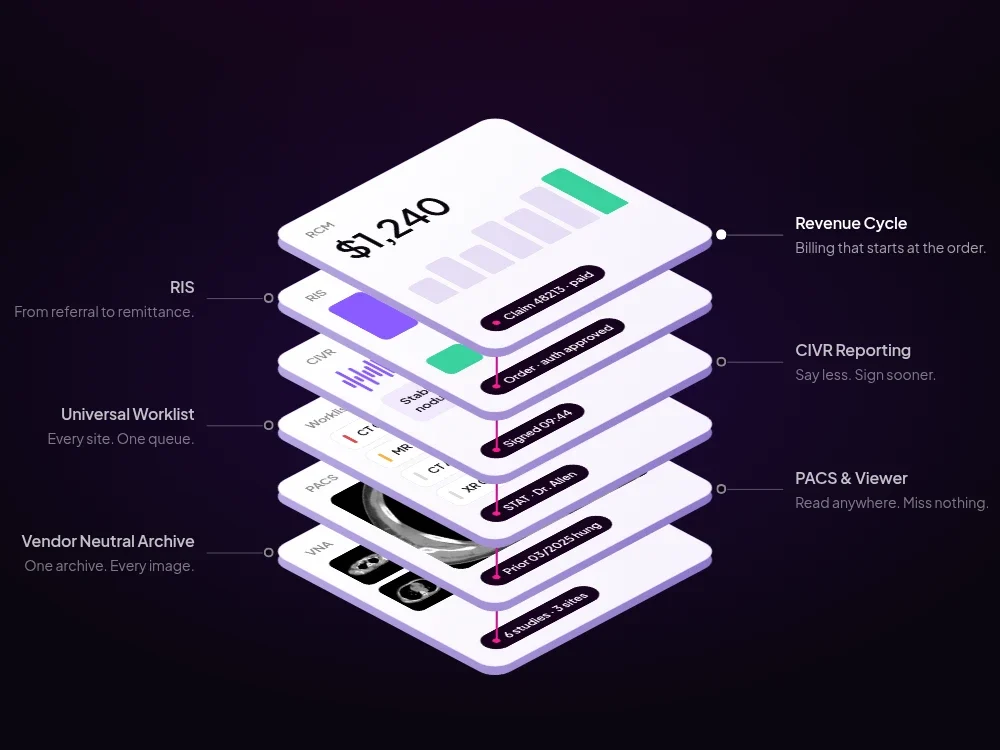
- Unified, workflow-native platforms. Embedding AI directly into reading, reporting and billing reduces context switching and shortens turnaround.
What leaders should do
Chopra’s advice: diagnose friction across imaging and administrative workflows, invest in tools that cut non-interpretive time, build scalable coverage through teleradiology and subspecialty networks, and ground adoption in clinician experience. “The goal is not to do more with less,” he writes. It is to redesign radiology for sustainability.
That is the approach behind the CIVIE platform, which puts reading, reporting and billing on one record, and behind CIVIE’s support for teleradiology groups.
Source: “Are We Reaching a Breaking Point?,” Dhruv Chopra, Imaging Technology News, February 24, 2026.